Cloth Diaper Absorbency Guide: Hemp vs Bamboo vs Cotton vs Microfibre | Bayrli®
Cloth Diaper Absorbency: Hemp vs Bamboo vs Cotton vs Microfibre
Choosing the right absorbency for your cloth diapers is one of the most consequential decisions you will make, and it is also one of the most confusing. There are four main materials used in cloth diaper inserts: hemp, bamboo, cotton, and microfibre. Each has distinct strengths and weaknesses, and understanding them will save you from leaks, unnecessary bulk, and wasted money.
This is not a theoretical exercise. The insert you place inside your baby's diaper determines how long that diaper lasts between changes, how slim it sits under clothing, how it performs overnight, and how it handles the difference between a gentle wetter and a baby who releases everything at once. The right material for daytime is not necessarily the right material for night. The right material for a newborn is not necessarily the right material for a toddler.
Here is what you need to know about each.
The Four Materials Compared
| Hemp | Bamboo | Cotton | Microfibre | |
|---|---|---|---|---|
| Absorption speed | Slow | Moderate | Moderate-fast | Fast |
| Total capacity | Highest | High | Moderate | Lowest |
| Compression resistance | Excellent | Good | Good | Poor |
| Trim factor | Most trim per unit of absorbency | Moderate | Moderate-bulky | Bulky when stacked |
| Skin safe (direct contact) | Yes | Yes | Yes | No — must use a barrier |
| Durability | Excellent | Good | Good | Degrades over time |
| Prep washes needed | 3–5 | 2–4 | 2–4 | 1 |
| Prone to odour retention | Low | Low | Low | Higher |
| Environmental footprint | Low (no pesticides, fast-growing) | Low (fast-growing, low-input) | Variable (organic = low; conventional = high) | Higher (synthetic, petroleum-derived) |
| Cost | Higher | Moderate | Low–moderate | Low |
| Best for | Overnight, heavy wetters, boosting | All-purpose day and night | Daytime, budget setups | Fast absorption layer on top |
Hemp: The Capacity Champion
Hemp is the most absorbent natural fibre used in cloth diapers. It holds approximately 2.5 times more liquid than microfibre of the same size while remaining noticeably trimmer. It is also the most resistant to compression leaks: when your baby sits or lies on a hemp insert, the liquid stays put rather than being squeezed out.
The trade-off is speed. Hemp absorbs slowly. If your baby is what the cloth diapering community calls a "flooder," meaning they hold their urine and release a large volume very quickly, hemp alone may not absorb fast enough to catch the initial surge. This is why hemp works best as an under-layer beneath a faster-absorbing material.
Hemp is naturally antimicrobial and does not require pesticides or herbicides to cultivate, making it one of the most environmentally responsible fibre choices available. It is also extremely durable; a hemp insert will outlast most other materials in your diaper stash.
Hemp inserts require three to five prep washes before they reach full absorbency. They can feel stiff after air drying; a brief tumble in the dryer softens them.
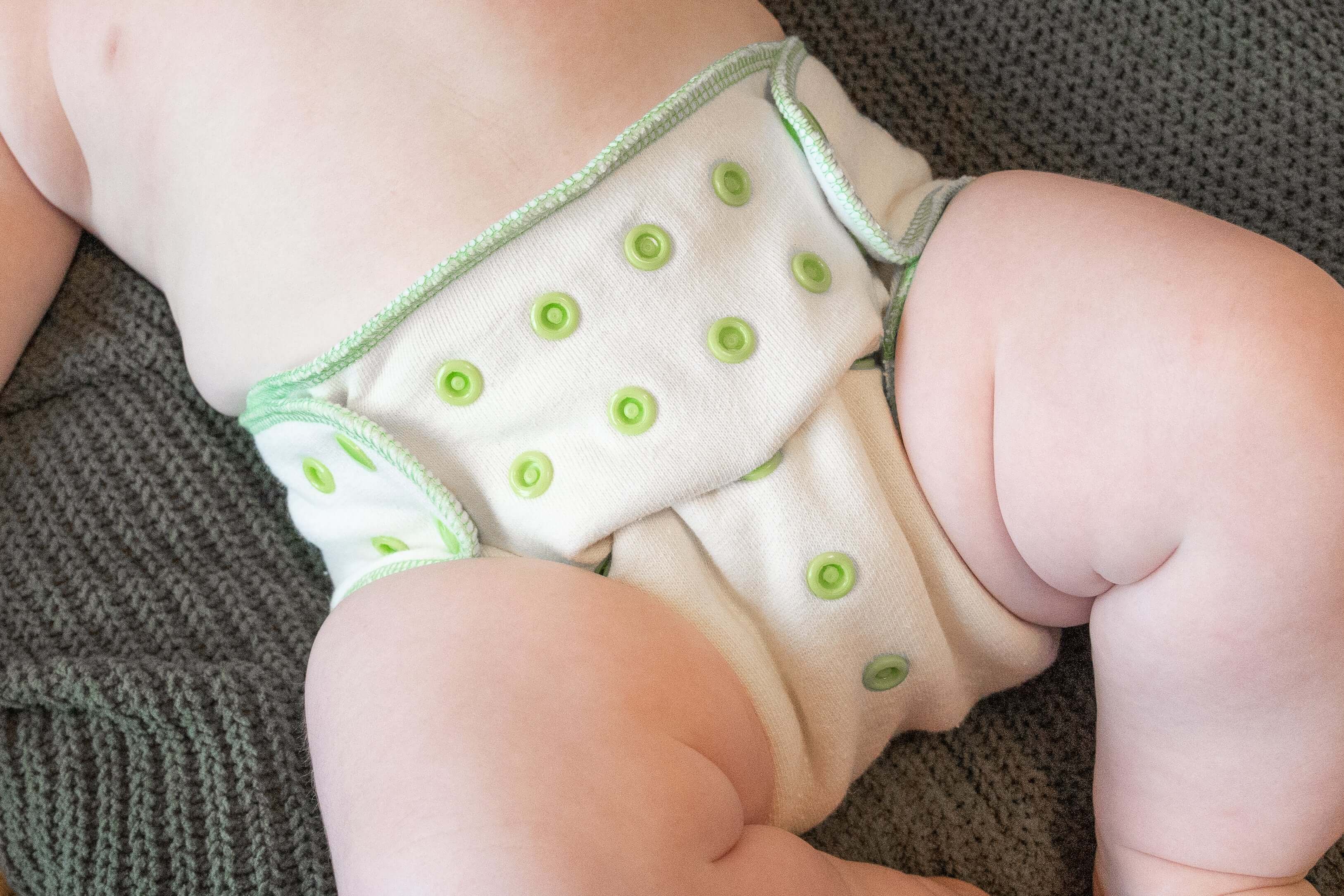
At Bayrli, hemp is the core material in our Inner fitted diapers and our hemp inserts, both of which are designed for maximum absorbency in overnight and extended-wear scenarios.
Bamboo: The All-Rounder
Bamboo offers the best balance of speed and capacity. It absorbs faster than hemp, holds more than cotton, and remains relatively trim. For most families, bamboo is the default choice for everyday daytime inserts and the first material to reach for when boosting absorbency.
Bamboo has excellent wicking properties, meaning it draws moisture away from the surface and distributes it through the fabric. This helps prevent the damp feeling that can cause nappy rash and discomfort, even when the insert is holding a significant volume of liquid.
One important clarification: not all "bamboo" inserts are genuine bamboo. Inserts labelled "charcoal bamboo" are almost always microfibre wrapped in a charcoal-coloured fleece layer. They perform like microfibre, not like bamboo. Check the material composition if it is not specified; genuine bamboo inserts will be labelled as bamboo viscose, bamboo rayon, or bamboo terry.
Bamboo requires two to four prep washes before first use.
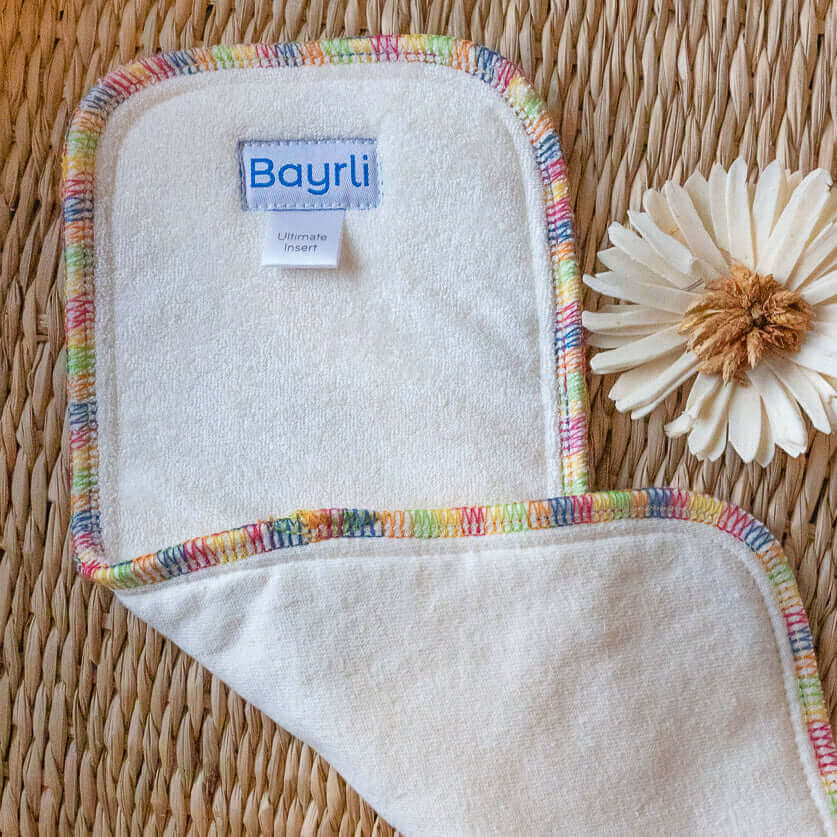
Our bamboo and bamboo cotton inserts are designed for daytime use and as boosters in overnight configurations.
Cotton: The Workhorse
Cotton is the original cloth diaper material and it remains an excellent choice, particularly for budget-conscious families. It absorbs at moderate speed, holds a reasonable volume, and is widely available in a range of formats: prefolds, flats, terry cloths, and inserts.
Cotton's primary advantage is versatility and cost. Prefolds and flats are the most economical way to cloth diaper, and they can be folded in multiple configurations to suit different needs and ages. Cotton also washes and dries easily and does not retain odours.
The limitation of cotton relative to hemp and bamboo is capacity per layer. To match the absorbency of a hemp insert, you need more layers of cotton, which adds bulk. For daytime use with regular changes, this is not a problem. For overnight or extended wear, cotton alone may not provide sufficient capacity without becoming uncomfortably thick.
Organic cotton is worth specifying. Conventional cotton accounts for roughly 10% of global agricultural chemical use. Organic cotton production eliminates synthetic pesticides and fertilisers. All skin-contact surfaces in Bayrli products use certified organic cotton.
Cotton requires two to four prep washes before first use.
Microfibre: Fast but Flawed
Microfibre is a synthetic material, a blend of polyester and polyamide, that absorbs liquid very quickly. It is the most common insert material in budget cloth diapers, and there is a reason for that: it is cheap to manufacture.
Microfibre has genuine utility as a top layer in an insert stack. Its fast absorption speed makes it effective at catching sudden, forceful urination before the liquid can escape the diaper. When paired with a higher-capacity natural fibre beneath it, microfibre contributes the speed component while hemp or bamboo provides the capacity.
However, microfibre has several significant limitations.
It cannot be placed directly against your baby's skin. Microfibre is so aggressively moisture-wicking that it draws moisture from the skin itself, causing dryness and irritation. It must always be used inside a pocket diaper or behind a fleece liner.
It is highly prone to compression leaks. When saturated, microfibre releases liquid under pressure like a sponge being squeezed. This makes it unreliable for sitting, car seats, and sleep positions that put weight on the diaper.
It holds less total volume than natural fibres. To match the capacity of a single hemp insert, you would typically need to stack two or three microfibre inserts, creating significant bulk.
It degrades over time. Microfibre loses absorbency with repeated washing, particularly in hard water. If you plan to reuse diapers for a second child, natural fibre inserts will perform far better on the second round.
It is a petroleum-derived synthetic that contributes to microplastic pollution with every wash cycle. If environmental impact is part of your decision-making, this is worth factoring.
Microfibre inserts require only one prep wash.
How to Layer Inserts for Best Results
The principle is simple: put the fastest-absorbing material on top and the highest-capacity material on the bottom. The top layer catches the liquid quickly; the bottom layer stores it.
The optimal stacking order, from top (nearest to baby) to bottom, is:
- Microfibre (fastest, but must not touch skin; only use inside a pocket or behind a liner)
- Cotton (moderate speed)
- Bamboo (moderate speed, high capacity)
- Hemp (slowest, highest capacity)
You do not need to use all four. For most daytime situations, a single bamboo or cotton insert is sufficient. For overnight, a bamboo insert layered over a hemp insert provides both speed and capacity. For a heavy wetter or flooder, a microfibre insert on top of hemp or bamboo inside a pocket diaper gives you the fastest possible absorption with the deepest capacity beneath.
Choosing by Scenario
Standard daytime use (changing every 2–3 hours): A single bamboo or cotton insert provides adequate absorbency for most babies. This is the simplest and trimmest configuration.
Heavy wetter or toddler daytime: Add a hemp or bamboo booster beneath your primary insert for additional capacity without excessive bulk.
Overnight (10–12 hours): Use a hemp fitted diaper with bamboo and hemp boosters, paired with a waterproof cover. See our overnight guide for the full setup.
Flooding (baby holds and releases large volumes at once): Place a fast-absorbing layer (microfibre or cotton) on top with a high-capacity layer (hemp) beneath. The top layer catches the surge; the bottom layer holds it.
Car seat or long outings: Prioritise compression-resistant materials. Hemp and bamboo hold liquid under pressure far better than microfibre. Avoid multi-layer microfibre stacks for extended seated periods.
Frequently Asked Questions
What is the most absorbent cloth diaper insert material? Hemp. It holds approximately 2.5 times the liquid of microfibre by weight and is the most resistant to compression leaks. However, hemp absorbs slowly, so it works best when layered beneath a faster-absorbing material like bamboo or cotton.
Can I use microfibre inserts directly against my baby's skin? No. Microfibre wicks moisture so aggressively that it can dry and irritate your baby's skin. Always use microfibre inside a pocket diaper or behind a fleece or cotton liner.
What are charcoal bamboo inserts? Despite the name, charcoal bamboo inserts are almost always microfibre wrapped in a charcoal-coloured fleece. They perform like microfibre, not like bamboo. If absorbency is your priority, choose genuine bamboo viscose, bamboo terry, or hemp inserts instead.
How many inserts do I need for overnight? This varies by baby. Most babies over 6 months do well with a hemp fitted diaper plus one or two boosters (bamboo and/or hemp). Our Overnight Bundle is configured for extended overnight wear. If you experience leaks, add another booster before trying a different approach.
Why are my cloth diapers leaking even with extra inserts? Adding more inserts does not always solve leaking. If the additional bulk is shifting the diaper out of position, or if you are experiencing compression leaks from too many stacked layers, the solution may be fewer, higher-capacity inserts rather than more layers. See our leaking troubleshooter for a systematic diagnosis.
Which insert material is best for sensitive skin? Natural fibres, specifically organic cotton, bamboo, and hemp, are all safe for direct skin contact and are breathable. Organic cotton is the gentlest option and is what Bayrli uses for all skin-contact surfaces. Avoid microfibre against sensitive skin.